Portal Frames
Portal frames, which originated in the Second World War, became popular in the 1960s. They are now commonly used to build wide-span structures such as warehouses, agricultural buildings, hangars, entertainment and sports facilities, factories, and large retail spaces that require an unobstructed clear area.
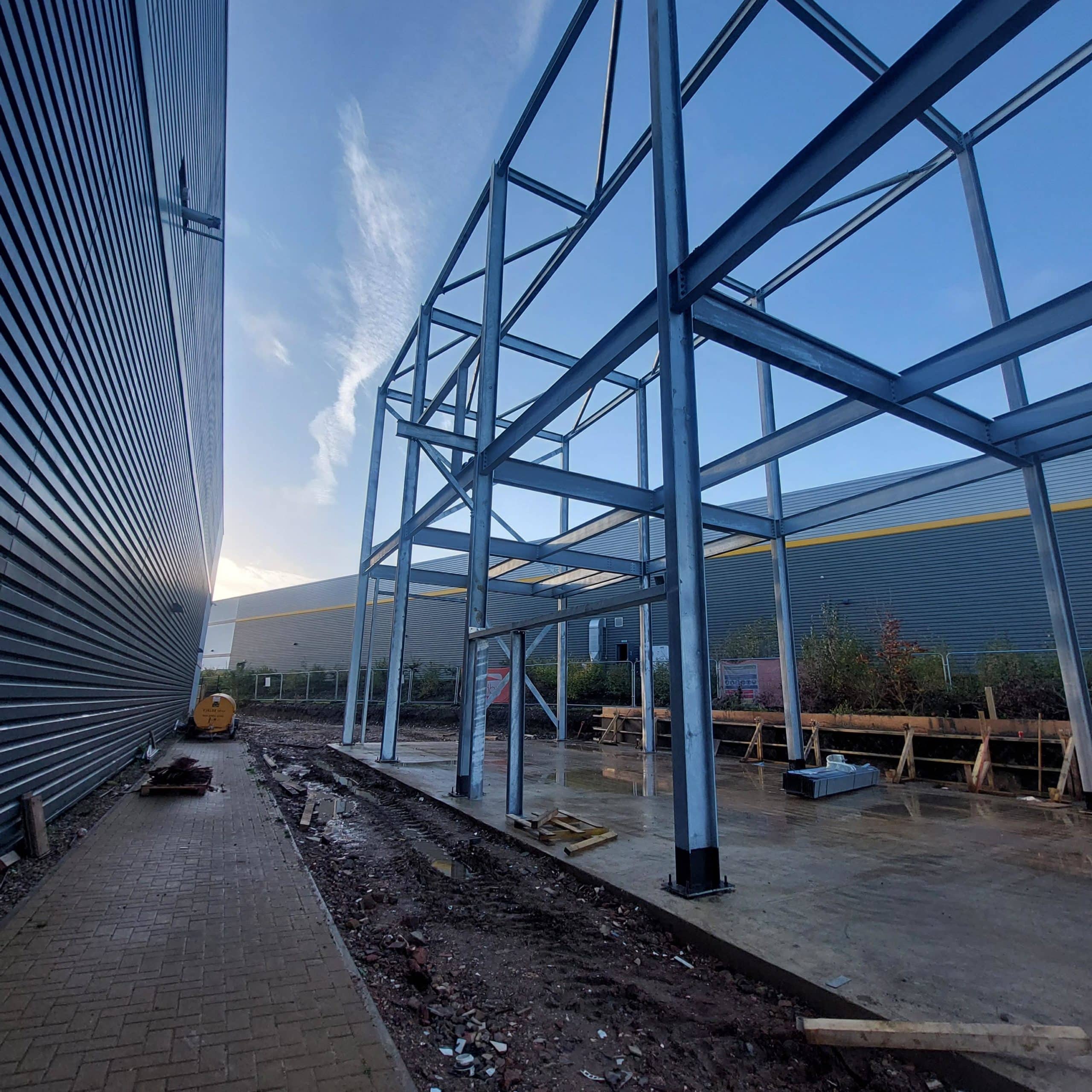
Portal frames offer a quick and straightforward construction method, resulting in a spacious, clear-span, weather-proof enclosure at a low cost and with minimal material. They are generally lightweight and can be prefabricated off-site before being bolted onto a substructure. The portal frames may remain visible within the internal space and can be aesthetically pleasing if designed thoughtfully.
Take a look at our FAQ’s to get an idea of what portal frames are available!
We are experts in our field, providing services to retail, office and public sectors for over 22 years
Get a free quote
Portal Frame Construction
Portal frames are made up of several important elements, these include:
- Columns: These vertical structures offer vertical support and seamlessly transfer loads to the structure’s foundation.
- Rafters: These pitched structures connect the columns, carrying loads across the structure to enhance durability.
- Bracing: These diagonal structures bolster the frame’s stability and stop the risk of any lateral movement.
- Purlins: These secondary beams help the roof covering and also transfer weight to the main structural frame.
When it comes to the construction of these frames, they are often fabricated off-site and then erected by expert installers using welding techniques or bolts. Once the frame has been erected, cladding and roof coverings are installed to envelop the structure and protect it against the elements.
FAQs
Portal frames contribute to the durability and stability of large steel structures. They offer numerous advantages, such as:
- Ideal for expansive, open, or continuous spaces like warehouses, distribution centers, and barns.
- Economical due to the reduced necessity for internal supports, which also lowers labor costs and construction time.
- Modular and adaptable designs that can meet various project requirements, enhancing overall flexibility.
The popularity of steel structures has soared due to their durability, lightness, and quick installation, making steel a go-to material in construction.
Key advantages of using steel include:
- Efficiency: Steel frames are typically 60% lighter than their reinforced concrete counterparts, leading to faster construction and lower shipping costs.
- Bespoke Designs: Designing structures with steel at the material does help when, in the future, you need to accommodate various additions such as mezzanine floors, bay areas, roller and dividing doors, and roof ventilation systems.
- Eco-friendliness: Steel stands out for its sustainability, being endlessly recyclable without quality degradation, thus offering long-term value.
- Safety: Managing steel is simpler than concrete or timber, reducing labour needs and the potential for on-site accidents. The use of pre-fabricated components, made under controlled workshop conditions, further enhances safety.
Yes there is….. take a look below
Single-Span Portal Frame
A single-span portal frame is the most basic and widely used type. It is composed of a rigid frame with two columns and a beam that spans horizontally or slopes between them. This design provides an unobstructed span between the columns, allowing for versatile interior space planning.
Commonly, it is utilised in residential garages, small warehouses, and workshops.
Multi-Span Portal Frame
A multi-span portal frame is made up of several single-span frames joined by intermediate columns and beams. This configuration is employed when a wider clear span is needed, surpassing what a single-span frame can support.
Tapered Portal Frame
Tapered portal frames feature beams and columns with variable cross-sections along their height. The size of these sections diminishes from the base to the ridge, ensuring that the rafters have a larger cross-sectional area where the bending moment is greatest, enhancing efficiency.
Such frames are also favored in architectural designs where aesthetics are key, such as for entry canopies, covered walkways, and grand entrances.
Curved Portal Frame
Curved portal frames boast a curved horizontal beam, as opposed to a straight one, adding a unique architectural element and visual interest to light commercial buildings.
These frames are ideal for structures like atriums, roof canopies, and other architectural elements that benefit from a distinctive curved shape.
Lean-To Portal Frame
The lean-to portal frame includes a single sloping roof supported by a main portal frame, often used to extend or annex existing buildings for additional space.
These frames are frequently seen in residential extensions, carports, covered patios, and storage areas.
Canopy Portal Frame
Designed for creating sheltered outdoor spaces, canopy portal frames have a single-span frame with a horizontal beam that projects beyond the supporting columns.
They are popular in residential settings for constructing covered porches, carports, and outdoor living areas.
Truss Portal Frame
Utilising trusses in the rafters and ridge, truss portal frames enable the widest spans among portal frame types.
Commonly employed in commercial warehouses, these frames are also found in light commercial buildings like retail spaces, showrooms, and smaller industrial units.

Mezzanine Floors
Are you looking for more space? Have you considered a mezzanine floor? A mezzanine floor is a great way to remain in your current premises whilst maximising the use of your available space. Whether you need additional storage, an office or production facility, a mezzanine could be a perfect solution.


Staircases
Whatever your staircase is to be used for, you can be sure that ATC will have a suitable solution. Staircases are not only functional, but can add aesthetic value to your new space, it may be that your new staircase is your daily means of access or better still, a statement piece!

Racking and Shelving
Our bespoke fabricated industrial racking and shelving solutions are tailored to suit a wide range of industries and applications, our custom designs maximise storage efficiency. We also provide SEMA racking & shelving inspections to assist with your business health & safety requirements.